New Zealand Campaign Medals - The New Zealand Operational Service Medal
About the New Zealand Operational Service Medal
The New Zealand Operational Service Medal (NZOSM) was instituted in 2002 for award to New Zealanders who have served on operations since 3 September 1945. The start date is the day after the surrender ceremony in Tokyo Bay, and is also the day after qualifying service towards medals for Second World War service (including the New Zealand War Service Medal) ended.
The NZOSM provides specific New Zealand recognition for operational service, and is awarded in addition to any New Zealand, Commonwealth or foreign campaign medal. It is awarded once only to an individual, regardless of how many times he or she has deployed on operations.
Personnel and veterans who have been awarded a campaign medal for operational service since 3 September 1945 qualify for the award of the NZOSM, provided that the particular campaign medal has been approved for acceptance and wear by New Zealanders. In addition, personnel who, under certain circumstances, have not completed the qualifying period for an approved campaign medal, but who have completed a specific period of service in an operational area towards such a medal (generally seven days on the posted strength of a qualifying unit), are eligible for the NZOSM. Full details on eligibility criteria and qualifying service are contained in the Royal Warrant and Regulations for the award.
To date, the NZOSM has been issued to over 20,000 veterans, currently serving military personnel and civilians. It is estimated that over 40,000 New Zealanders are eligible for this medal.
The NZOSM is a silver medal suspended from a black and white ribbon. On the obverse, the New Zealand Coat of Arms indicates that the medal specifically recognises service on behalf of New Zealand.
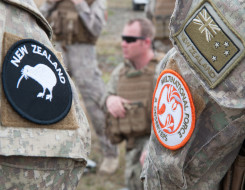
The reverse of the medal depicts a kiwi, facing or moving to the right, with below a wavy line and the inscription “FOR OPERATIONAL SERVICE”. The lines below the kiwi’s feet represent land, the wavy line represents sea and the background field represents air, providing an overall allusion to the movement of New Zealand military personnel by land, sea and air.
The New Zealand Herald of Arms, Mr Phillip O’Shea, LVO, designed the NZOSM and its ribbon. Mr O’Shea has designed most New Zealand awards instituted since 1973 including the Queen’s Service Order and the New Zealand Order of Merit, and campaign medals such as the New Zealand General Service Medal 1992, New Zealand General Service Medal 2002 and the East Timor Medal.
Engraving
The NZOSM was issued unengraved until 30 June 2009, except for the NZOSMs for those who had died on operational service. From 1 July 2009 all NZOSMs have been issued engraved on the bottom rim. For military personnel, the recipient's service number, rank, initials, surname, and corps / Service are engraved. These details are as at the date of the operational service which qualifies him or her for the NZOSM.
Note: Recipients of unengraved NZOSMs should contact the Medals Office if they wish their NZOSM to be engraved. The best opportunity to have your NZOSM engraved is when you need to add another medal (such as the New Zealand Defence Service Medal) to your mounted medal group.
About the ribbon
The colours of the ribbon allude to those generally regarded as the national colours of New Zealand, black and white. These colours were first adopted by the New Zealand troops in the South African War (1899-1902). The colours were used for the New Zealand War Service Medal, the New Zealand Service Medal 1946-1949 and the East Timor Medal . The distinctive design makes the statement that it is a New Zealand medal. When worn and overlapped with other medals the distinctive design remains visible.
Royal Warrant
The Royal Warrant for The New Zealand Operational Service Medal can be viewed here.
Medal Regulations
The Regulations for The New Zealand Operational Service Medal can be viewed here.
Clasps and Bars
There are no clasps or bars for this medal.
Order of Wear
The NZOSM is worn before all other operational medals awarded for service since 3 September 1945. The position of the NZOSM in the Wearing of Medals in New Zealand Table can be viewed here.
Note for lateral recruits: In the case of NZDF personnel who have previously served in overseas armed forces and have campaign medals which are authorised for wear in NZ, when they become eligible for the award of the NZOSM by serving on operations with the NZDF the NZOSM will take precedence over these medals. The NZOSM will be the first medal for operational service worn, followed by others in order of date of award to the individual.
Media Statements concerning the New Zealand Operational Service Medal
- 18 March 2002 - Medallic Recognition for Nuclear Test Veterans and Further Details on the New Zealand Operational Service Medal
- 11 June 2002 - Inaugural Presentation of new Operational Service Medal
A selection of photographs of the 11 June 2002 Presentation Ceremony can be viewed here. - 3 September 2003 - Medal Presentation to the Next of Kin of those on the Roll of Honour - Presentation at Parliament Buildings, Wellington
A selection of photographs of the 3 September 2003 Presentation Ceremony can be viewed here. - 27 November 2003 - Next of Kin receive Operational Service Medals - Presentation at the Auckland War Memorial Museum
A selection of photographs of the 27 November 2003 Presentation Ceremony. - The New Zealand Roll of Honour - 3 September 1945 to the present.
Naval Deployments which Qualify Veterans for the NZOSM Only under the 7 Days' Operational Service Criteria
- HMNZS Black Prince - June 1955 to July 1955 (for 9 days' operational service during the Malayan Emergency)
- HMNZS Royalist - February 1959 to June 1959 (for 7 days' operational service during the Malayan Emergency)
- HMNZS Taranaki - December 1963 to August 1964 (for 8 days' operational service during the Indonesian Confrontation)
- HMNZS Canterbury - 27 November 1997 to 10 December 1997 (for 14 days' operational service off Bougainville)
- HMNZS Te Mana - 10 June 2000 to 21 June 2000 (for 12 days' operational service in the Solomon Islands)
- HMNZS Te Kaha - 21 June 2000 to 6 July 2000 (for 16 days' operational service in the Solomon Islands)
- HMNZS Te Kaha - 24 August 2000 to 13 September 2000 (for 21 days' operational service in the Solomon Islands)
- HMNZS Te Mana - 27 April 2001 to 14 May 2001 (for 18 days' operational service in the Solomon Islands)
Land and Air Service which Qualify Veterans for the NZOSM Only under the 7 Days' Operational Service Criteria
- Berlin Airlift - 1 September 1948 to 11 August 1949 (for operational service during the Berlin Airlift)
- Singapore - 1 February 1959 to 31 July 1960 (for operational service during the last 18 months of the Malayan Emergency, which cannot be recognised by the General Service Medal 1918-62 with clasp "Malaya").