Three Services as one force, being the best in everything we do  

WEARING MEDALS

      Quick Links

Mounting of Medals

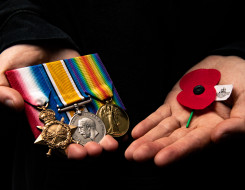
Before an Order, Decoration or Medal can be worn, it must be provided with a form of attachment to a uniform jacket or coat. This is called mounting and there are two recognised forms. A medal is said to be "Swing Mounted" when it is suspended by its ribbon from a ribbon bar or brooch pin. Several medals can be attached to a long brooch pin bar however damage can occur from contact between these 'free swinging' medals. The alternative method, generally used where the owner wants to protect the medals from contact damage, is called "Court Mounting". Medal ribbons are stretched over a stiff mounting board with a medal bar brooch attachment at the top. Where many awards are to be worn, the medals are slightly overlapped so that they take up less space.

Order of Precedence for Mounting

Medals must be mounted in the correct order of precedence in accordance with the New Zealand Order of Wear. The medal in the group with the highest precedence is mounted at the right hand end (nearest the lapel) of the medal bar descending to the lowest precedence medal at the left hand end. In New Zealand, the medal with the highest precedence is the Victoria Cross and the lowest would be some awards made by foreign Governments. Miniature medals and medal ribbon bars are mounted in the same sequence. When ribbons alone are worn, only four or five ribbons can be mounted in one row on a ribbon bar before a second row centred above the first is started. The senior medal ribbon is displayed on the top row closest to the lapel and the junior medal on the bottom row furtherest from the lapel.

Many medals experts and collectors specialise in mounting medals and they will be able to advise on all aspects of mounting and the correct Order of Wear. A guide to the correct Order of Wearing of Medals in New Zealand can be viewed here. The purpose of this guide is to assist medal recipients to determine the correct order in which their medals should be mounted and worn. It should be noted that the Wearing of Medals in New Zealand Table needs to be interpreted for each individual medal holder, for the reasons discussed at the end of the Wearing of Medals in New Zealand Table.

The official New Zealand Order of Wear

The official New Zealand Order of Wear is maintained by the Honours Secretariat, Department of Prime Minister and Cabinet. The current version of the official New Zealand Order of Wear is published on the Honours Secretariat website.  A guide to the correct order of wear of New Zealand orders, decorations and medals, based on the official New Zealand Order of Wear, is provided on the NZDF Medals website.

Wearing of Medals by Family Members

Next-of-kin and other relatives of deceased servicemen and women have recently been authorised to wear their relative's medals on specific occasions and under certain circumstances. This applies to both military and civilian next-of-kin and other relatives of former New Zealand services personnel. Medals must be worn on the right breast rather than the left to differentiate between former servicemen and women and next-of-kin or other relatives. The wearing of a relative's medals is a matter of personal discretion and limited to days of remembrance. Only service medals and decorations mounted on a medal bar (full-size or miniature) can be worn by a relative; neck badges, sashes, sash badges, or breast stars cannot be worn. The occasions on which wearing of relatives medals is permitted are confined to ANZAC Day (25 April) and Remembrance Day (11 November). In addition, it may be appropriate for next-of-kin and other relatives to wear relative's medals on an occasion where either the relative's service or the unit in which they served is being commemorated.

Wearing of Medals by Civilians

Ex-service personnel who were entitled to wear medals while in uniform may continue to do so in civilian clothing on appropriate occasions. The medals are mounted and worn in exactly the same manner as for uniformed wear. The wearing of miniature medals by both male and female ex-service personnel is designed to make wearing much more practical and comfortable while in evening dress. The wearing of miniature medals by civilians at other times (for example, during commemorative services or parades) is not officially recognised.

Wearing of Ribbon and/or Medals for Military Service by personnel of the New Zealand Police, New Zealand Fire Service, and other New Zealand Government Agencies

The New Zealand Police and the New Zealand Fire Service are Government agencies within a country for which Her Majesty The Queen is the Head of State. Therefore, all awards approved for wear in the official Order of Wear may be worn on Police uniform, Fire Service uniform, and any other official New Zealand agency uniform. A Government agency may stipulate that no medals or ribbons are be worn on their uniform.  However, a Government agency may not stipulate that only their own Long Service and Good Conduct Medal be worn on their uniform.

Fraudulent Wearing of Medals

No person, with the exception of a direct descendant of a deceased service man or woman, may wear medals which have not been awarded to him or her personally. This also applies to the wearing of miniature medals and medal ribbons. In addition, no person may wear a medal or decoration awarded to them by a foreign government unless it has been approved for wear by the Sovereign. The Military Decorations and Distinctive Badges Act 1918 and the Military Decorations and Distinctive Badges Amendment Act 1974 refer.

Wearing of Lifesaving Medals

The award of official Government medals for acts of bravery and self- sacrifice in saving life is only relatively recent. Prior to the introduction of medals such as the Albert and George medals, it was left to private organisations to honour those who risked their lives to save others. Many organisations such as the Royal Humane Society, the Royal National Lifeboat Institution, Order of St John and Lloyds of London as well as cities and both private and public companies struck and issued lifesaving medals. British lifesaving medals were awarded to New Zealanders until 1998 when a specific range of New Zealand Bravery Awards designed to recognise both military and civilian personnel was instituted. Some organisations such as the Royal Humane Society and Order of St John still continue to issue lifesaving medals in their own right. Medals issued by the British or New Zealand Governments for saving life are assigned a place in the New Zealand Order of Wear and are to be worn with other Honours, Decorations and Medals on the left breast. All other lifesaving medals are to be worn on the right breast.

Quick Links


 This page was last reviewed 15 April, 2010 and is current.